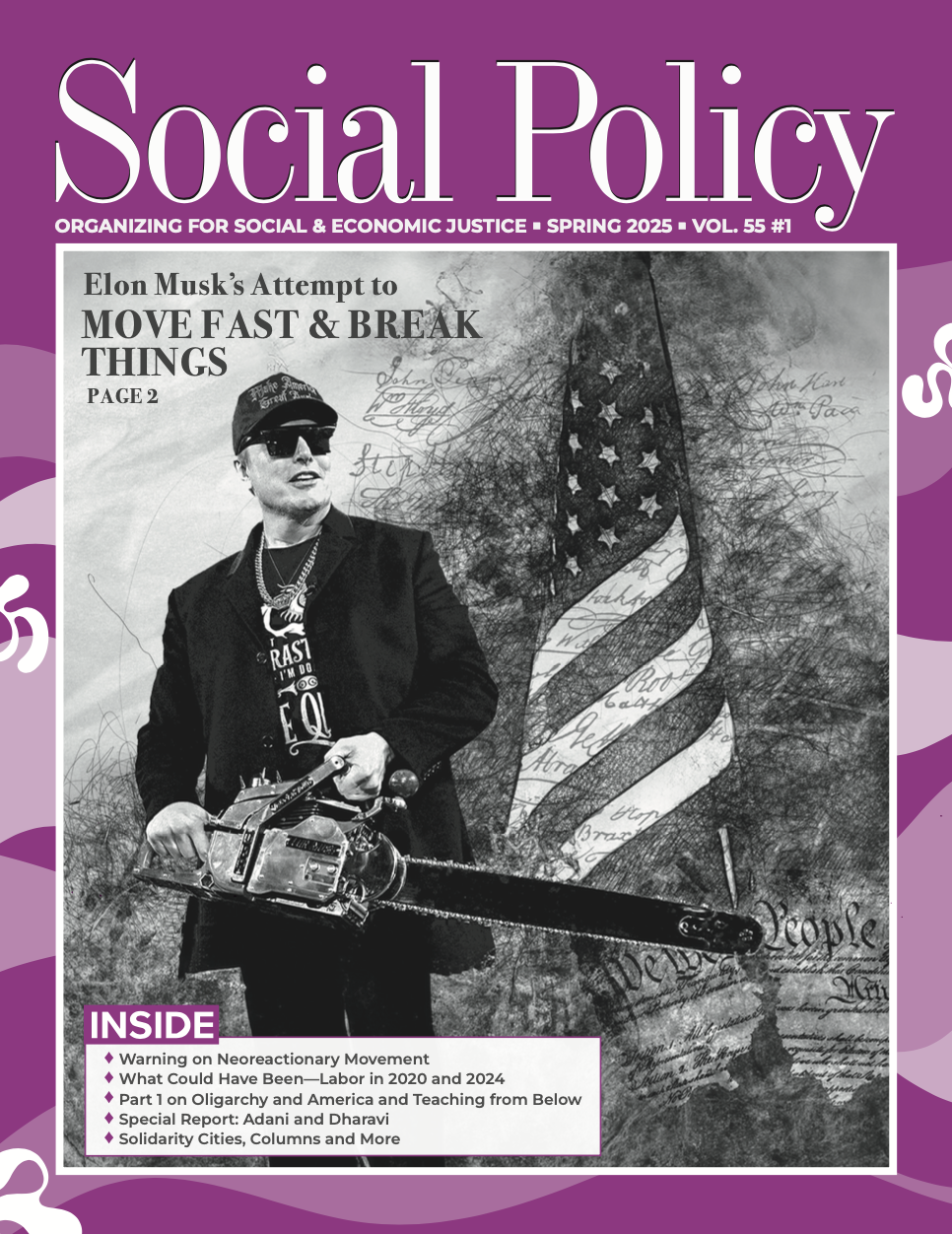





We all knew it was going to be bad, but most of us never imagined it would be quite this bad. Having lived through Trump I, we thought we would be saved by his inattention, incompetence, and lack of follow through. None of that has changed, but Trump II has subcontracted governing to Elon Musk, a specialist in slash-and-burn, who may not have proven his competence, but, Lord almighty, he does get things done, one way or another, and does so ruthlessly and without apology, despite myriad mistakes and incalculable harm. Trump for now, seems more than happy to go along for the ride, as long as the headlines spell his name right.
Our first piece, anonymously, but frighteningly, tells us that this neoractionary program may have gone from provocative theory to double trouble in no time. Read and learn, because unless stopped, we haven’t seen nuthin’ yet! Steve Early looks at what might have been, if labor was willing to play to its strength in politics, not in terms of donations, but in deeply involving and mobilizing the rand-and-file, whether for Bernie Sanders or Kamala Harris.
Moshe ben Asher and Khulda Bat Sarah rose to the moment with a warning that we are offering in two-parts about the impact of these politics, particularly in regards to tariffs and China. The daily headlines echo their points as the economy heads down and the stock market, Trump’s favorite measure, tanks. Mike Miller, another longtime contributor, in the first of two parts, reminds us all that organizing successfully requires paying attention to the basics and that means communicating clearly and fully with people about their issues and interests, and walking the road with them to the end.
One of the many shocking developments in Trump’s early days was his “pause” on the enforcement of the Foreign Corrupt Practices Act. We include a special report by ACORN’s research director Elliott Anderson that connects that dot to India and the charges involving mega billionaire Gautam Adani, accused under FCPA of deceiving US investors and others through $250 million in bribes in India. The other dot that’s connected is to ACORN India’s work in Dharavi in the middle of Mumbai, where under equally controversial means, Adani has won and is now trying to implement the Dharavi Redevelopment Program. ACORN members are fighting for a right-to-return, not simply a giveaway for more Adani riches. The excerpt this issue by a team of authors looks at what the solidarity economy looks like on the ground in Philadelphia, Worcester, and New York City. If only Adani and Indian Prime Minister Narendra Modi could understand how solidarity cities work, they would see in Dharavi where the same kind of solidarity is coupled with livelihood, as manifested by our women’s waste collective and informal worker associations that have proven their value there for decades.
Our columnists are also up for this challenge. Phil Mattera hits squarely at the Musk DOGE chaos and its attempt to take the heat off of the problems with contractors like Musk’s own operations and blame federal workers and programs instead. Drummond Pike pulls the string harder on the neoreactionaries, and why we need to be ready and move hard. John Anderson rues the fact that the New Democratic Party is losing at the polls, as a coalition partner to an increasingly unpopular government, despite delivering huge benefits to Canadians. Gregory Squires reminds us the diversity, equity, and inclusion is about getting the best workers, not privileging any special group.
In the United States, we’re seeing what “flooding the zone” feels like when the government is weaponized about the people, and it’s not pretty. This issue is part of preparing the pushback.
Editor’s Note: Social Policy found this in our in-box thanks to one of our subscribers via several of our faithful readers and contributors. The piece is anonymous on purpose. One of the authors is rumored to be Dave Troy an investigative reporter. These days staying behind curtains, especially when looking into the darkness is just solid common sense, so whomever pulled all of these strains together, the only certainty was that it was important to bring this to our readers for their own preparation and actions in defense of whatever remnants of democracy can be saved against the assault.
Overview
Events of the last three weeks constitute a greater and more immediate threat to the American Constitutional order than has yet been widely recognized. While America's attention is now trained on the chaos, illegality, and unprecedented aggression with which Elon Musk's team is inserting itself into the U.S. government, the threat is an order of magnitude beyond an executive power grab.
As documented below, Musk is tied to a broader group (including Peter Thiel, Marc Andreessen, other Silicon Valley tech elites, and thought leader Curtis Yarvin) called the Neoreactionaries (NRx), whose extremist ambitions - if realized - are an immediate, existential threat to the very existence of the American nation-state. The Neoreactionaries have openly stated their aims: to destroy the nation-state and the Constitutional order and replace them with a new privately owned corporate state, to be run by a CEO-dictator. Citizens become subjects owned by the state - "state slaves" - because "everything rots when it has no owner—human beings included" (Yarvin 12/28/24).
Read more: The Imminent Neoreactionary Threat to the American Republic
Every four years, like clockwork, our two major parties serve up presidential candidates whose commitment to the cause of labor is more rhetorical than real.
This is most obviously true of conservative Republican courting of working-class voters. That venerable bait-and-switch routine reached its 21st century apex in the form of Donald Trump’s successful faux populist campaigns for the White House in 2016 and 2024. Post-election, his first and now second administration quickly displayed little interest in helping anyone other than Trump’s own billionaire class supporters.
Editor’s Note: This valuable how-to piece from a veteran organizer is presented in two parts with the second coming in 55.2. Make notes and stay tuned.
Introduction
For the past forty-plus years, I have been a community organizer, working with religious, labor, interest/identity/and issue organizations, (and teaching in universities). As my work continued, I sought to systematize a way to introduce community people to aspects of political and sociological theory—i.e. how do citizens, potential citizens, residents of a place, workers, unemployed people, welfare recipients, pastors and lay leaders, and others answer the question, “How do I understand the world in which I am living?” I used a highly interactive workshop in which I asked a lot of questions, and workshop participants supplied the answers. The sequence of the questions is connected with what workshop participants are doing in their community (or labor) organizations, and builds on scenarios that are familiar to them in their own organizational work.
Read more: Teaching “From Below” How the World Works – Part I
The re-election of Donald Trump as US President has drawn the world’s eyes to the power of the ultra-rich to set the political agenda, take control of government and use that power for their personal profit. In India, these forces have been at play for over a decade under the government of Narendra Modi. ACORN members in India are now at the forefront of a battle against those forces. On the one side are the residents of Dharavi, a community of thousands of people in the heart of Mumbai in India threatened with mass eviction and unemployment. On the other side, one of the world’s richest men, Gautam Adani, stands to expand his multi-billion-dollar empire. However, this is more than a local fight between a powerful developer and local residents. The Adani empire is supported by powerful allies: MAGA-boosting U.S. Congressmen, wealthy investors and – crucially – pension savings of millions of everyday people. As Adani has “gone global” to build his empire, ACORN is responding in kind – asking people if their retirement savings are funding the evictions in Dharavi.
Read more: Special Report: The Tenacles of the Adani Bribery Scandal and its Impact on Dharavi
An Excerpt from Solidarity Cities: Confronting Racial Capitalism, Mapping Transformation collectively written by Maliha Safri, Marianna Pavlovskaya, Stephen Healy, and Craig Borowiak.
In cities powerfully shaped by racial capitalism and economic exclusion, communities have long fought to reclaim their futures through economic solidarity and cooperation. This has been the case through the darkest stages of racial capitalist urban history and remains crucial in the face of a resurgent patriarchal white supremacy today. Our research reveals a striking pattern: the very neighborhoods redlined into disinvestment and organized abandonment decades ago have become hubs of worker cooperatives, credit unions, community gardens, and mutual aid networks that together constitute the decentralized but vibrant solidarity economy movement.
Read more: EXCERPT - The Solidarity Economy is Thriving in Cities
Donald Trump and Elon Musk seem gleeful about the chaos they have unleashed on the federal workforce. Claims that the onslaught is designed to root out fraud and waste while promoting efficiency are spurious. The examples of waste offered by DOGE are usually erroneous or trivial, and there is nothing efficient about the way agencies are being ravaged. Nor does it make sense to fire inspectors general, the professionals most skilled at addressing corruption.
Nearly 3 years ago, a long-haired, hippie looking software developer and wannabe political theorist, Curtis Yarvin, published a paper entitled “The Butterfly Revolution.” (https://graymirror.substack.com/p/the-butterfly-revolution) Elsewhere in this issue, you will see an anonymously compiled report circulating in tech circles that describes how this butterfly is taking flight. While it sounds pretty benign, it is one of the most frightening ideas I’ve yet to encounter. Yarvin’s adherents ensure his ideas ought to scare the lights out of any reasonable person who still believes that the American model of democracy has merit. They include J D Vance, Peter Theil, Marc Andreessen, and others who embrace his ideas for replacing democratic governance with a sovereign CEO or monarch who has the power to replace all government employees with loyalists who would then run the country like an efficient corporation.
The NDP - the so-called conscience of the country, and the reason Canadians have public healthcare and other treasured social programs—is falling fast in the polls leading up to the federal election, likely to take place before copies of Social Policy Magazine arrive in your mailbox. They are paying the price for propping up Justin Trudeau’s minority government for nearly three years in exchange for valuable but enigmatic pharmacare and dental care programs.
Read more: NORTHERN LIGHTS - Don't Miss A Chance to Organize Your Base
Loyalty, Not Ability, Drives Trump’s Attack on Diversity, Equity and Inclusion
When it comes to DEI (diversity, equity and inclusion) President Trump and his minions have it exactly backward. Rather than reducing the qualifications of employees DEI actually enhances the chances of finding the best and the brightest. They know this, but they don’t care. When it comes to hiring or firing, talent matters little. It’s loyalty that counts.
As an organizer, over the decades, I’ve learned that to win campaigns, it’s important to understand fully those who oppose you. I’ve also found that sometimes our enemies understand us better than our allies, because, frankly, they’ve also paid more attention in order to beat us. These are early days, and I don’t mean to offend, but Trump in inadvertently teaching all of us who are in the business of helping people who have not had power what it takes to exercise power and make change.
Read more: BACKSTORY 55.1 - Trump’s Lessons in Making Change